

802.1X authentication
802.1X authentication is the who and how of network access control: before a switch or access point opens a port, the device — or its user — has to prove an identity. Taranac runs a dedicated FreeRADIUS instance for NAC (separate from the AAA RADIUS used for device administration) that terminates the EAP exchange, checks credentials or certificates against your identity stores, and hands the result to the NAC policy engine, which decides what access to grant (VLAN, ACL, redirect).
This page covers the four methods Taranac supports — EAP-TLS, PEAP, EAP-TTLS and MAB — how each behaves, which identity store and certificates each needs, and when to pick which. Authorization (profiles and rules) lives on the NAC policy page.
- marker peap → peap
- marker ttls → eap_ttls
- EAP + client cert → eap_tls
- no EAP → mab
The four methods at a glance
Section titled “The four methods at a glance”| Method | Proves identity with | Inner method | Works for directory users | Needs client cert | Needs NT-hash |
|---|---|---|---|---|---|
| EAP-TLS | Client X.509 certificate | — (cert only, in the TLS handshake) | Yes | Yes | No |
| PEAP | Username + password | EAP-MSCHAPv2 | A directory that can prove an MS-CHAPv2 response — Active Directory (domain join) or FreeIPA (ipaNTHash) | No | Yes — stored for local users, read live for FreeIPA, never seen for AD |
| EAP-TTLS | Username + password | PAP, MSCHAPv2, or EAP-MSCHAPv2 — all three | Yes — any directory type (over PAP) | No | Only on the MSCHAPv2 inner methods, where it behaves exactly like PEAP |
| MAB | MAC address only | — | n/a | No | No |
A single Taranac NAC server offers all four at once. The supplicant on the
endpoint chooses the EAP method; MAB is the fallback when no supplicant answers.
Each request is tagged with its detected method (eap_tls, peap, eap_ttls,
mab), and policy rules match on that tag.
Key concepts
Section titled “Key concepts”- Supplicant — the 802.1X client on the endpoint (Windows native client,
wpa_supplicanton Linux, the macOS/iOS/Android built-in client). It selects the EAP method and presents the credential or certificate. - Authenticator — the switch or access point (a NAS) that brokers EAP between the endpoint and Taranac over RADIUS, and enforces the result on the port.
- Identity store — where Taranac verifies the credential: the local user directory, or an external LDAP directory — Active Directory, OpenLDAP, FreeIPA or another LDAP server.
- EAP tunnel — PEAP and EAP-TTLS first build a TLS tunnel (the endpoint validates Taranac’s server certificate), then carry the password inside it. EAP-TLS has no inner tunnel: the certificate exchange in the TLS handshake is the authentication.
- Qualified identities — a supplicant may send the login as
DOMAIN\aliceoralice@domain.example. Taranac tries the name exactly as sent first, and a qualified name may then only ever resolve to a directory account. Before 1.2.2 the qualifier was stripped and matched against local accounts too, soANY_PREFIX\alicewas a free alias for the localalice— invisible in the log, which named the bare account either way. The log still records the string the client sent, because for MS-CHAPv2 that string is part of the cryptogram; the account it resolved to is what policy uses. Applies to PEAP and EAP-TTLS alike. - MAB (MAC Authentication Bypass) — for devices with no supplicant. The switch sends the endpoint’s MAC address as the username; Taranac looks it up in the endpoint inventory instead of checking a credential.
EAP-TLS — certificate-based
Section titled “EAP-TLS — certificate-based”EAP-TLS authenticates with a client certificate during the TLS handshake itself. There is no password and no inner tunnel: the endpoint presents an X.509 certificate, FreeRADIUS validates it against the trusted-CA bundle, and Taranac extracts the identity from the certificate.
This is the strongest method and the recommended one for managed corporate devices. It works for both user certificates and machine certificates (a domain computer authenticating before anyone logs in).
Identity extraction. After a successful handshake, Taranac looks for a user in the certificate in this priority order:
- SAN UPN (
user@domain.local) - SAN email
- Common Name (CN)
- the outer
User-Name, as a last resort
If a UPN carries a domain suffix and nothing matches, the bare part before the
@ is tried too. A user certificate resolves to a user (and that user’s groups)
for policy evaluation. A machine certificate that matches no user is treated as a
machine-cert flow — the user is empty and the endpoint itself carries the
identity. The endpoint’s identity is read the other way round: SAN dNSName
first, then the CN, and that value becomes both the endpoint’s certificate
identity and its hostname, which the cert_identity_pattern and
hostname_pattern classification rules then match on.
Trust. Taranac does not run its own CA by default for trust decisions — it validates client certificates against a CA bundle assembled from three sources: an internal CA hierarchy, uploaded Trusted CAs (for contractors, BYOD, or partner organisations), and per-domain CA certificates attached to an LDAP/AD configuration. Issuer trust, CRL/OCSP revocation checking and the server certificate that FreeRADIUS presents are all managed on the PKI & trust page.
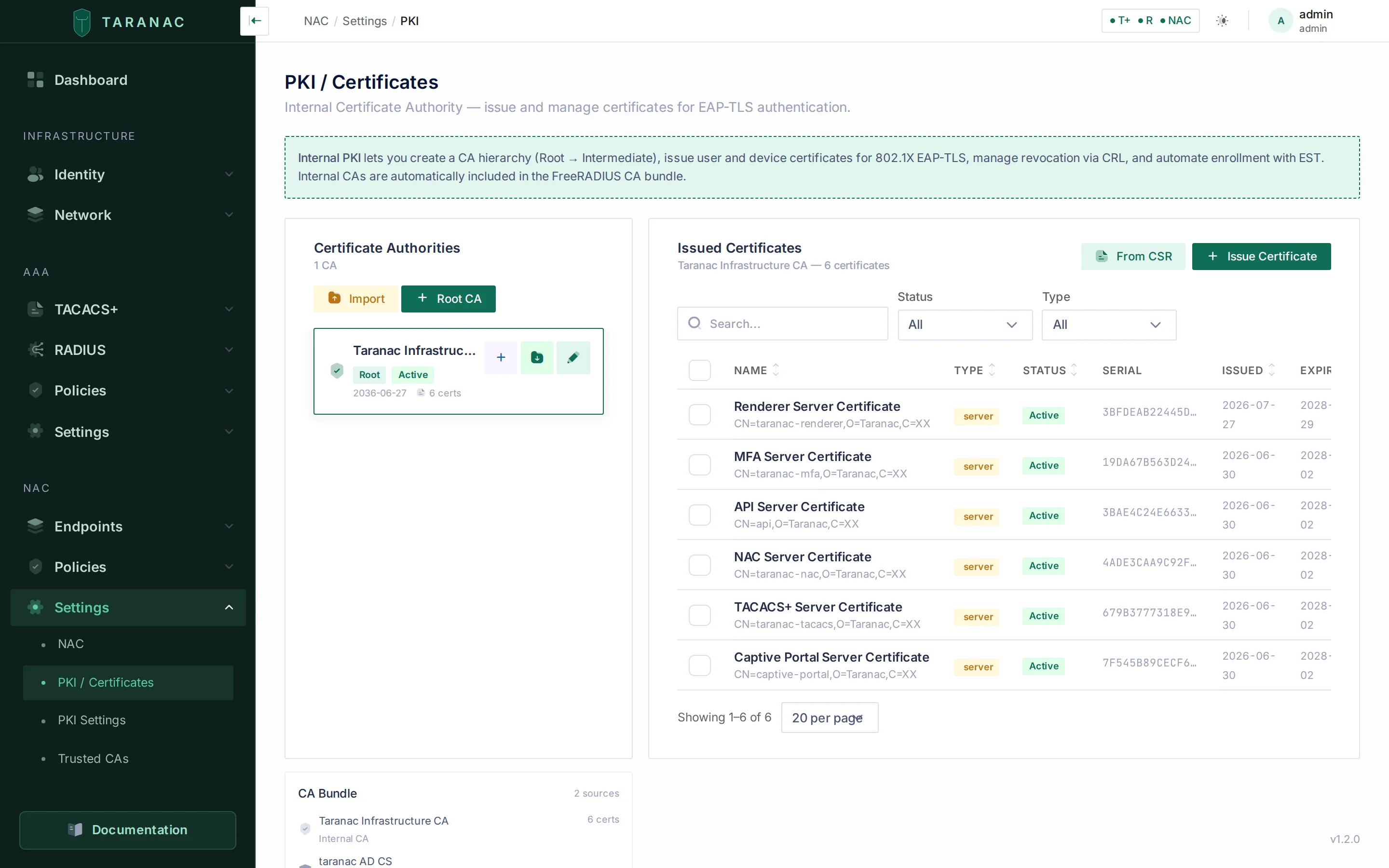 PKI & trust — the CA bundle EAP-TLS validates client certificates against.
PEAP — password inside a TLS tunnel
Section titled “PEAP — password inside a TLS tunnel”PEAP (Protected EAP) builds a TLS tunnel using Taranac’s server certificate, then runs EAP-MSCHAPv2 inside it to verify a username and password. It is the default method on Windows and the most common password-based choice.
The catch: MSCHAPv2 is a challenge-response protocol, so the password’s NT-hash is needed to verify it. Taranac has three ways to get one, and which one a login takes is decided by the user’s own directory, never by the installation:
- Local Taranac users — the hash is stored beside the account and checked locally. An account whose password was set before NT-hashes were kept has none; re-saving the password generates it.
- Active Directory accounts — the hash is unreadable by design (
unicodePwdis write-only), so a domain controller has to prove the response. That needs the node to hold a machine account, which is why Active Directory requires the domain join on the MS-CHAPv2 tab of the LDAP configuration. Onewinbindd, one join, one domain: at most one configuration can own it. - Directories that publish the hash as an ordinary attribute — FreeIPA
generates
ipaNTHashfor every user, byte for byteMD4(UTF-16LE(password)), even whereipa-adtrust-installwas never run. Since 1.2.8 Taranac reads it and verifies the response itself: no domain, no join, no winbind. The hash is read per login and stored nowhere. Unlike the domain, this mechanism is not exclusive — any number of such directories can serve PEAP at once, alongside a joined domain.
FreeIPA needs one action on the directory side: ipaNTHash sits in an explicit
exclusion list even in the administrator’s own ACI, so an ACI granting the bind
account read access has to be added. The MS-CHAPv2 tab generates the LDIF with
your bind DN and search base filled in, and Check the directory reports
whether the hash is readable. A missing ACI is reported as exactly that, never as
a wrong password — FreeIPA answers without the attribute rather than refusing, and
counting that as a bad password would feed the brute-force guard.
Directories that publish no hash and cannot hold a machine account still cannot
serve PEAP — OpenLDAP, Google Workspace and generic LDAP. Such an attempt is
refused by name (mschap_domain_not_joined) rather than as a wrong password, and
is not counted as a credential attempt; route those users to EAP-TTLS or
EAP-TLS instead. See LDAP directories, which carries
the directory-side mechanics, and RADIUS
for the same branches on the device-administration side.
Windows PEAP supplicant settings that matter
Section titled “Windows PEAP supplicant settings that matter”PEAP has been tested end-to-end with the native Windows 10/11 supplicant against Taranac. A few client-side settings are load-bearing:
| Setting | Recommended | Why |
|---|---|---|
| Verify server certificate | On | Protects against a rogue RADIUS server. Requires importing Taranac’s server CA into the Local Machine trust store (the supplicant runs as SYSTEM and cannot see the user store). |
| Connect to these servers | Fill in the server cert CN | Pins the expected RADIUS identity. |
| Trusted Root CAs | Select Taranac’s CA explicitly | With server verification on, an unselected CA fails the check. |
| Inner method | EAP-MSCHAPv2 | The only inner method Taranac supports for PEAP. |
| Automatically use Windows logon name | Off for a local Taranac account | When on, Windows sends a qualified name (COMPUTER\user), and since 1.2.2 a qualified name may only ever resolve to a directory account — so it no longer finds the local one. For a domain account on a domain PC it is fine. |
| Cryptobinding TLV | Off | FreeRADIUS does not implement the Microsoft PEAPv0 cryptobinding extension; with it on, Windows will not connect. |
EAP-TTLS — password for directory users
Section titled “EAP-TTLS — password for directory users”EAP-TTLS also builds a TLS tunnel with the server certificate, and Taranac accepts all three of the inner methods a supplicant may choose inside it. They are told apart by what the tunnel actually carries, not by anything you configure:
| What arrives inside the tunnel | Inner method | How the password is checked |
|---|---|---|
User-Password, no EAP | PAP | Taranac holds the plaintext, so it verifies directly (below) |
MS-CHAP2-Response, no EAP | MSCHAPv2 (native, non-EAP) | Exactly the PEAP path: NT-hash, domain, or hash-reading directory |
EAP-Message | EAP-MSCHAPv2 | The same PEAP path again |
Native EAP-TTLS/MSCHAPv2 — what a supplicant sends with no EAP inside the tunnel — failed for everyone before 1.2.2, including a local account with the correct password. The inner method is recorded on the log row and shown beside the Auth Method badge for EAP-TTLS only, because PEAP always tunnels EAP-MSCHAPv2 and repeating it would be noise — while inner PAP means the password crossed the tunnel in the clear, which is worth seeing at a glance.
With PAP — the usual choice, and the one that reaches every directory type — Taranac receives the actual password and verifies it directly:
- Directory users — Taranac performs an LDAP bind as the user. On Active
Directory that is a direct bind as
user@domain; on OpenLDAP, FreeIPA and other types the account’s DN is resolved first (inside the configured search bases) and the bind uses that DN. The directory checks the password; nothing is stored locally. This is the password-based 802.1X method that works for every directory type, whatever it can or cannot do about NT-hashes. - Local users — the password is checked with argon2id against the stored hash (no NT-hash needed).
A failed bind spends the account’s lockout budget in the directory exactly as an MS-CHAPv2 check does, so Taranac holds further binds for an identity after repeated failures rather than letting a looping supplicant lock the account out. That hold is shared with the PEAP path, because the directory counts both against one account.
EAP-TTLS is native on Linux (wpa_supplicant default), macOS, iOS and Android.
On Windows it is supported but not the default, so it usually requires GPO or
manual supplicant configuration.
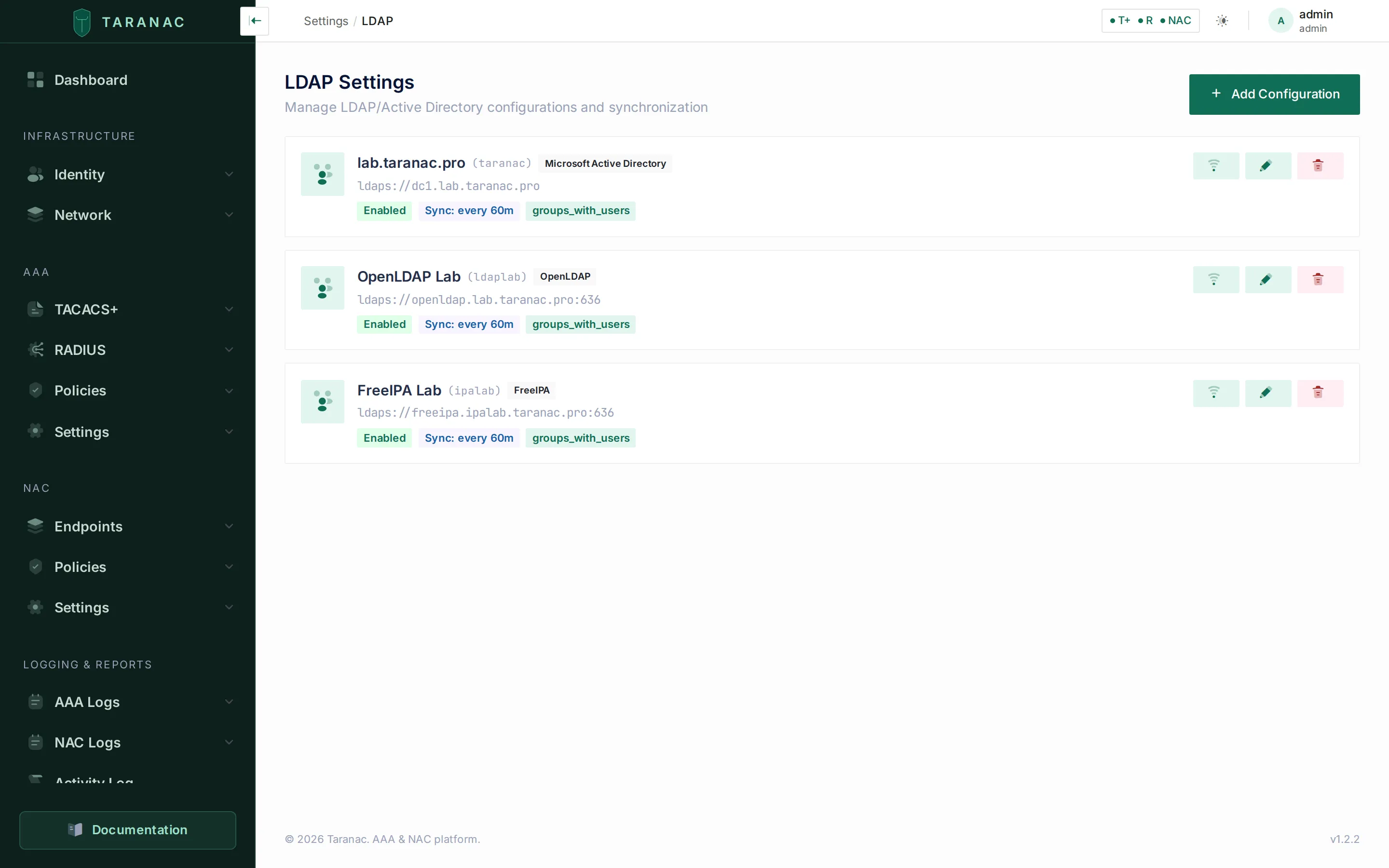 Directory configurations — the identity stores EAP-TTLS binds against. Any type works here: this installation carries Active Directory, OpenLDAP and FreeIPA at once.
MAB — for devices with no supplicant
Section titled “MAB — for devices with no supplicant”Printers, IP phones, cameras and most IoT devices have no 802.1X supplicant. When the switch’s EAP exchange times out, it falls back to MAC Authentication Bypass: it sends the device’s MAC address as the username. Taranac does not check a credential — it looks the MAC up in the endpoint inventory, and if the endpoint exists and is not blocked, the request proceeds to policy evaluation. Unknown MACs can be auto-discovered, classified, and (via policy) redirected to a captive portal.
MAB proves possession of a MAC address, nothing more — a MAC is easily spoofed. Treat it as device identification, not authentication, and scope MAB rules to restricted VLANs and ACLs.
How a request is classified
Section titled “How a request is classified”Every request lands in policy evaluation tagged with one method. Taranac decides the tag from the RADIUS attributes FreeRADIUS provides:
| Signal, most reliable first | Detected as |
|---|---|
Inner-tunnel marker ttls — the inner tunnel ran to completion | eap_ttls |
Inner-tunnel marker peap — likewise | peap |
| EAP present and any client-certificate attribute (serial, issuer, subject, or any SAN — not the CN alone) | eap_tls |
| EAP present, no client cert, no marker, but the daemon’s failure message names the EAP type | that type (13 → eap_tls, 21 → eap_ttls, 25 → peap) |
| EAP present, nothing identifies the method | peap, as a last-resort guess |
| No EAP at all | mab |
Policy rules then match on this tag — for example IF [EAP-TLS] user in [Domain Users], or IF [MAB] endpoint in [Printers]. A rule with method Any
matches regardless. See NAC policy for how the who/what/where/when
conditions combine.
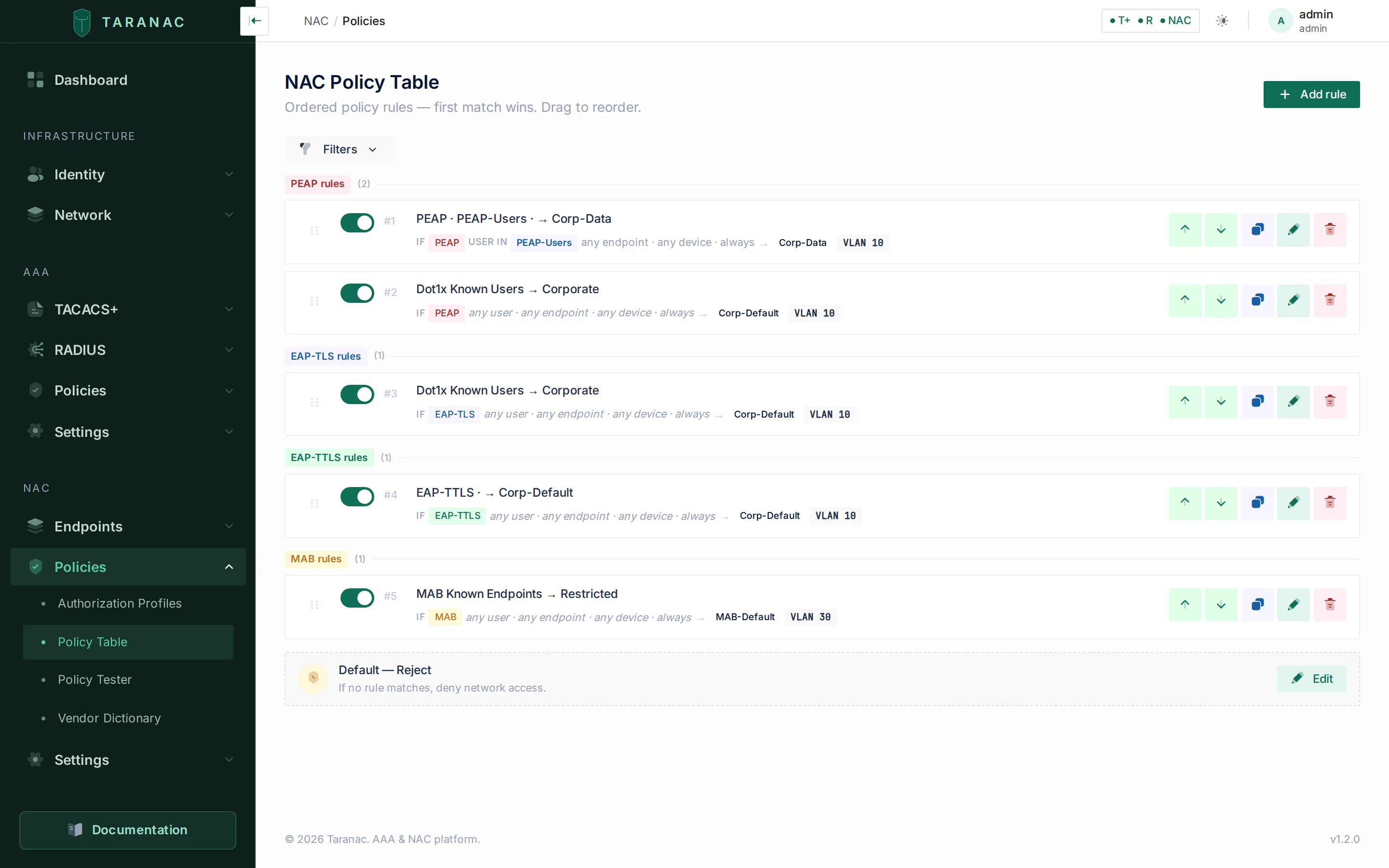 NAC policy — rules are grouped by the authentication method they match.
What the log records about the port and the VLAN
Section titled “What the log records about the port and the VLAN”Every 802.1X and MAB authentication lands in Logging & Reports → NAC Logs → Auth Log. Two of its columns answer questions the AAA logs deliberately do not: which interface did this endpoint authenticate on, and which VLAN was it in.
The interface. Switches report the port in whatever shape their vendor chose.
Cisco says GigabitEthernet0/3 and MikroTik says ether2, and those pass through
unchanged. Huawei and H3C/Comware encode it, and since 1.2.6 both encodings are
decoded — by shape, not by detected vendor, because a reject path has no resolved
vendor and H3C inherited the same formats:
What the NAS sends in NAS-Port-Id | What the NAS Port column shows |
|---|---|
GigabitEthernet0/3, ether2 — already readable | the value itself |
slot=0;subslot=0;port=18;vlanid=121;interfaceName=GigabitEthernet0/0/18 | GigabitEthernet0/0/18 — the vendor’s own interfaceName always wins |
the same key=value form with no interfaceName (or unit= on a Comware stack) | the composed path slot/subslot/port — no media type is knowable, so none is invented |
0000018000000121 — the 16-digit form, slot(2) + subslot(2) + port(3) + vlanid(9) | the same path, but only when every field lands inside the range the vendor documents; otherwise the raw string stands, because a confident wrong answer is worse |
The raw value is kept beside the readable one and shown on hover, so nothing is lost; the column sorts on the parsed name, and free-text search matches it. The same value appears as Interface in the detail panel of both the auth log and sessions, in endpoint discovery, in CSV and XLSX exports, and in both NAC report templates. It is filled in as authentications arrive — records written before the upgrade keep an empty Interface, because the raw value they stored is the only evidence there is.
The VLAN. An authentication row carries two numbers with two meanings: the
VLAN the matched profile assigned, and the VLAN the NAS reported — read
from a Cisco vlan-id AV-pair, from vlanid= inside NAS-Port-Id, or from
Tunnel-Private-Group-ID, in that order. A disagreement between them is not
flagged here, deliberately: on an authentication record the reported VLAN is the
one the frame arrived in before any assignment was applied, so flagging it would
light an icon on every ordinary dynamic-VLAN authentication. On a live session
the same disagreement is flagged, because that is where the port settled after
authorization — see Sessions.
This is where public issue #11 started: a MAB’d IP phone tags its own voice VLAN,
so there is nothing for a profile to assign and the VLAN appears only inside
NAS-Port-Id. An empty assigned VLAN on such a row is a deliberate configuration,
not a gap.
When to use which
Section titled “When to use which”| Your situation | Use | Notes |
|---|---|---|
| Managed corporate laptops/desktops | EAP-TLS | Strongest. Needs cert provisioning (e.g. AD CS auto-enrollment) and the issuing CA trusted in Taranac. |
| Domain computers authenticating before login | EAP-TLS (machine cert) | Machine identity; classify into a “Domain Computers” endpoint group. |
| Contractors / BYOD / partner devices with certs | EAP-TLS (Trusted CA) | Upload the partner CA as a Trusted CA; resolve to a local user or leave as endpoint identity. |
| LDAP/AD users with passwords | EAP-TTLS | Works against every directory type, whatever it can do about NT-hashes — verified by an LDAP bind. |
| Directory users on Windows’s default supplicant | PEAP | Needs a directory that can prove MS-CHAPv2: Active Directory on a domain-joined node, or FreeIPA with ipaNTHash readable. |
| Local Taranac users with passwords, Windows default | PEAP | Requires the account’s NT-hash to be stored. |
| Printers, phones, cameras, IoT (no supplicant) | MAB | Identification, not authentication. Scope to restricted access. |
| Unknown device, no supplicant, unknown MAC | MAB → captive portal | Policy redirects to a portal for guest/BYOD/AUP onboarding. |
A practical layered design: EAP-TLS for everything that can hold a certificate, EAP-TTLS for directory users who authenticate with a password, PEAP where the supplicant leaves you no choice and the directory can prove an MS-CHAPv2 response, and MAB (scoped tight) for the headless devices that have no other option.
Common scenarios
Section titled “Common scenarios”- Corporate employee (EAP-TLS, user cert). Laptop presents a user certificate; Taranac extracts the UPN from the SAN, resolves the user and their groups, and policy assigns the corporate VLAN.
- Domain computer (EAP-TLS, machine cert). Machine authenticates before login with a computer certificate; no user matches, so the endpoint carries the identity (hostname enriched from the cert) and policy places it in a machine VLAN.
- Linux workstation, directory user (EAP-TTLS).
wpa_supplicantsends the password over PAP inside TLS; Taranac binds to the directory as that user —user@domainon AD, the resolved DN on OpenLDAP or FreeIPA; on success, policy applies the user’s group rules. - Local admin account on Windows (PEAP). Username/password verified via MSCHAPv2 against the stored NT-hash.
- FreeIPA user on Windows (PEAP). The supplicant offers nothing but
PEAP-MSCHAPv2; Taranac reads
ipaNTHashfrom the directory for that login, verifies the response itself, and stores nothing. No domain join is involved, and a joined Active Directory on the same node is untouched by it. - Network printer (MAB). No supplicant, so the switch sends the MAC; Taranac finds it in the “Printers” endpoint group and policy assigns the printer VLAN.
Related
Section titled “Related”- NAC overview — how NAC fits together and differs from AAA.
- NAC policy — authorization profiles and rules (the what).
- Endpoints — endpoint inventory, groups and classification.
- PKI & trust — server certificate, internal CA, trusted CAs, CRL/OCSP.
- Captive portal — onboarding for unknown devices.
- Taranac on GitHub