

OUI database
The first bytes of a MAC address are assigned by the IEEE to the company that made the network interface. The OUI database is Taranac’s local copy of those assignments. It is where the Manufacturer of every endpoint comes from, and it answers without any network access, for every device, including one that has never said a word about itself.
It is found under NAC → Discovery Sources → OUI Database.
Key concepts
Section titled “Key concepts”| Term | What it means |
|---|---|
| OUI / prefix | The part of a MAC address the IEEE assigned to one organisation: 24, 28 or 36 bits long, depending on the registry. |
| Registry | One of the five lists the IEEE publishes: MA-L, MA-M, MA-S, IAB and CID. |
| Manufacturer | The organisation name for the longest prefix that matches a MAC, plus a short display name. |
| Randomised MAC | A locally administered address a phone or laptop invents per network. No manufacturer can be read from it. |
The five registries
Section titled “The five registries”| Registry | Prefix length | What it is |
|---|---|---|
| MA-L (large) | 24 bits (XX:XX:XX) | The classic OUI: about 16 million addresses per block. Most of the table. |
| MA-M (medium) | 28 bits (XX:XX:XX:X) | About a million addresses per block. |
| MA-S (small) | 36 bits (XX:XX:XX:XX:X) | About 4,000 addresses per block. |
| IAB | 36 bits | The older form of the small block. |
| CID | 24 bits | Company IDs, for organisations that need an identifier and do not build hardware under it. |
All five are loaded, because the finer blocks are carved out of 24-bit blocks the IEEE registers to itself. A table holding only MA-L answers IEEE Registration Authority for every device from a small manufacturer. That is not a manufacturer. The makers behind these blocks are largely sensor, controller and embedded-device firms, precisely the devices that cannot do 802.1X and are admitted by MAB.
How it works
Section titled “How it works”Longest prefix wins
Section titled “Longest prefix wins”A lookup tries the longest prefix first: 36 bits, then 28, then 24. A MAC such as 70:B3:D5:CB:1A:2B sits inside both IEEE’s own 24-bit block and a manufacturer’s 36-bit block. Longest first finds the manufacturer:
70:B3:D5 (MA-L, 24 bits) IEEE Registration Authority70:B3:D5:CB:1 (MA-S, 36 bits) RADAR ← the answerWhere the data comes from
Section titled “Where the data comes from”- First start. Taranac downloads all five registries from
standards-oui.ieee.org. If none can be fetched, it loads the bundled snapshot shipped in the image, which covers all five registries (about 58,000 prefixes). An offline installation therefore names manufacturers from the start. The snapshot is loaded only into an empty table. It never overwrites data a sync has already brought. - Weekly update. Every Sunday at 02:00 the leader downloads the registries again, when Auto-update is on (the
nac.oui_auto_updatesetting under NAC Settings, on by default). If only some registries answer, the update goes ahead with those, and the others are tried again the next week. If none answer, nothing changes until the next run. - Sync Now on the page runs the same update on demand. It takes 30 to 60 seconds, reports how many prefixes were added and updated, and fails cleanly, leaving the table as it was, if the IEEE is unreachable.
An update adds new prefixes and updates changed names. It does not delete a prefix the IEEE has withdrawn, so a rule written against an old name keeps matching.
On an installation with no route to the internet, the table stays at the snapshot of the release it was first installed with.
The OUI Database page
Section titled “The OUI Database page”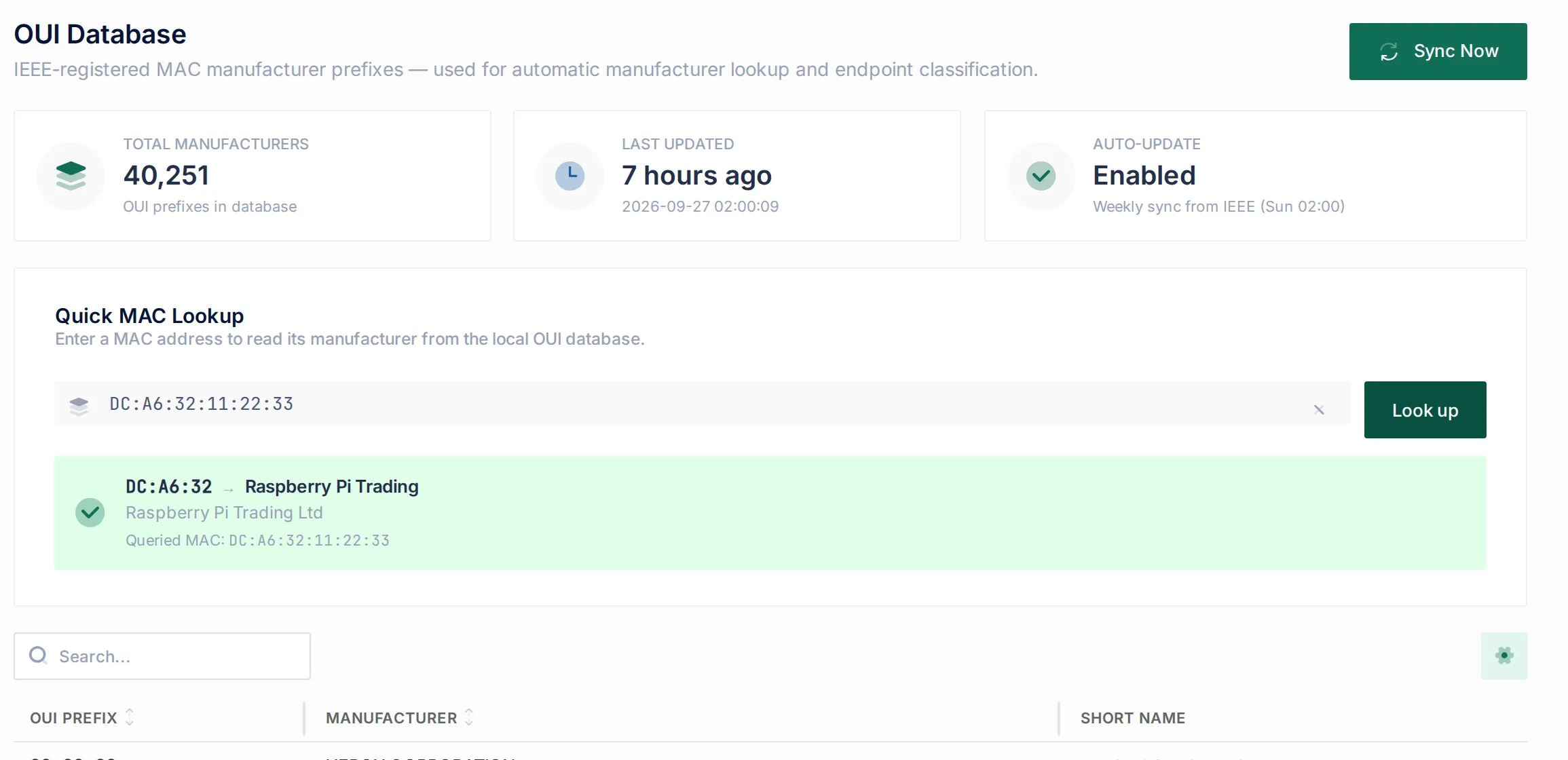
- Total manufacturers: how many prefixes the table holds.
- Last updated: when a sync last changed it.
- Auto-update: whether the weekly sync is on.
- Quick MAC Lookup: type a MAC (
AA:BB:CC:DD:EE:FF) or a prefix (AA:BB:CC) and read the manufacturer from the local table, with the matching prefix. - The table: OUI Prefix, Manufacturer, Short Name. The search box matches by hex prefix when you type hex (
DC:A6,DCA632), and by name otherwise.
Viewing the page needs the Endpoints view permission. Sync Now needs Endpoints edit.
How the manufacturer is used
Section titled “How the manufacturer is used”The endpoint’s Manufacturer. When an endpoint is created, its Manufacturer (vendor) and OUI prefix (oui_prefix, always the first three bytes of the MAC) are filled from the table. The name is stored as plain text, not as a link to the table. An IEEE rename does not silently change what your existing endpoints and rules say. Where a list or journal shows a manufacturer for a MAC that is not stored with one, such as the DHCP Probe’s messages, it is looked up when displayed, so it follows the latest sync.
Classification. Two endpoint group rule types read it. vendor_name matches the manufacturer. If the stored endpoint has none, it is looked up from the MAC. oui_prefix matches the first three bytes. Both rule forms have a picker over this table, so you can find a manufacturer and see how many prefixes it owns. A vendor_name rule for a name the table does not hold yet is saved anyway, and starts matching once a sync brings that manufacturer.
Device Profiling. The Manufacturer prefix (OUI) signal lets a profiling rule conclude a manufacturer, or more, from the first three bytes. It is present for every device with a globally assigned MAC. See Device profiling.
Web Probe. A source can send vendor and oui_prefix to your script, and an endpoint a Web Probe creates is given its manufacturer at once.
When to use what
Section titled “When to use what”| You want to match… | Use |
|---|---|
| Everything a manufacturer makes, whatever block it came from | vendor_name |
| One specific 24-bit block, such as one product line that has its own OUI | oui_prefix |
| A device from a 28- or 36-bit block | vendor_name: its first three bytes belong to the IEEE’s shared block, not to the maker |
| A randomised MAC | Neither can work. Use a host name, a certificate, a directory rule or a profile. |
Reference
Section titled “Reference”| Item | Value |
|---|---|
| Menu | NAC → Discovery Sources → OUI Database |
| Registries | MA-L, MA-M, MA-S, IAB, CID from standards-oui.ieee.org |
| Matching | Longest prefix first: 36, 28, then 24 bits |
| Offline | Bundled snapshot of all five registries, loaded into an empty table when the IEEE cannot be reached |
| Schedule | Weekly, Sunday 02:00, leader only (job OUI Database Update) |
| Setting | nac.oui_auto_update (default true) |
| Permissions | Endpoints: View (page, lookup); Edit (Sync Now) |
Related
Section titled “Related”- Discovery & profiling: the other sources.
- Endpoints: the Manufacturer field and classification rules.
- Profiling rules: the manufacturer-prefix signal.