

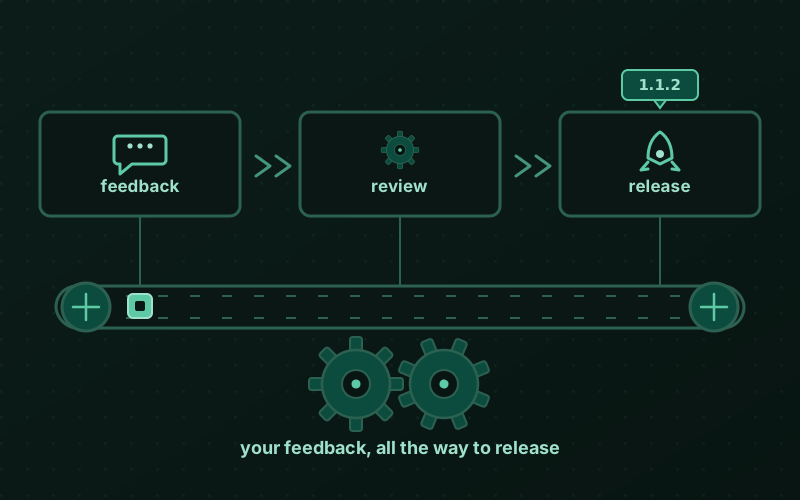
Before the changelog, the important part: thank you. To everyone who pulled the images, stood Taranac up against real gear, and then took the time to write in when something felt off — this release is mostly yours. Almost every item below started as a message, an issue, or a “hey, is this supposed to…” — and that feedback loop is exactly what a young project lives on. Keep it coming.
Here’s what 1.1.2 changes.
Vendor authorization profiles now deploy exactly as previewed
The headline fix, and the one that mattered most to the people who found it. If you
built a TACACS+ authorization profile on a non-shell vendor template — Juniper
junos-exec, FortiGate, Palo Alto and friends — the per-profile preview looked
perfect, but the deployed daemon config quietly collapsed it into a generic
shell / privilege-15 block. The Policy Tester preview showed the same flattened
version, so the two agreed with each other and disagreed with what you actually
authored.
The daemon config now renders every vendor service and raw attribute, matching the per-profile preview one-to-one. What you see is what the box gets.
LDAP failures that tell you why
A failed LDAP / Active Directory login used to report a flat “invalid credentials” no matter what actually went wrong. Now it names the real cause — wrong password, account locked, disabled, expired, or “must change password.” Less guesswork at the help desk, faster answers for the person locked out.
MFA replay protection, now cluster-wide
A one-time TOTP code is supposed to be exactly that — one time. It turned out that in a multi-worker or multi-node deployment, a code could be replayed inside its short validity window by aiming the retry at a different worker process or cluster node, because “already used” was tracked per process. Used codes now live in a shared store, so a code burned on one node is burned everywhere. If you run Taranac clustered, this one’s worth the upgrade on its own.
The smaller sharp edges
- Correct privilege level on a brand-new user’s first login. A user created moments earlier could authenticate but land on a default privilege level for that first session — the authorization step didn’t yet know about them. It now loads the user the same way login does, so the privilege from the matched policy rule applies immediately.
- Matched policy rule, by ID. The TACACS+ authentication and authorization log detail now show the UUID of the rule that matched, next to its name — a stable handle for correlation and scripting, even after a rule gets renamed.
- New-IP alert emails name the browser. The “sign-in from a new IP” notification used to render an empty Browser row; it now reports the client’s browser (or “Unknown” for header-less API callers).
Self-hosted, artifact-only, Elastic License 2.0. Small, fast, and shaped by the people using it — that’s the cadence we want to keep. Found another rough edge? Tell us; the next one has your name on it too.