

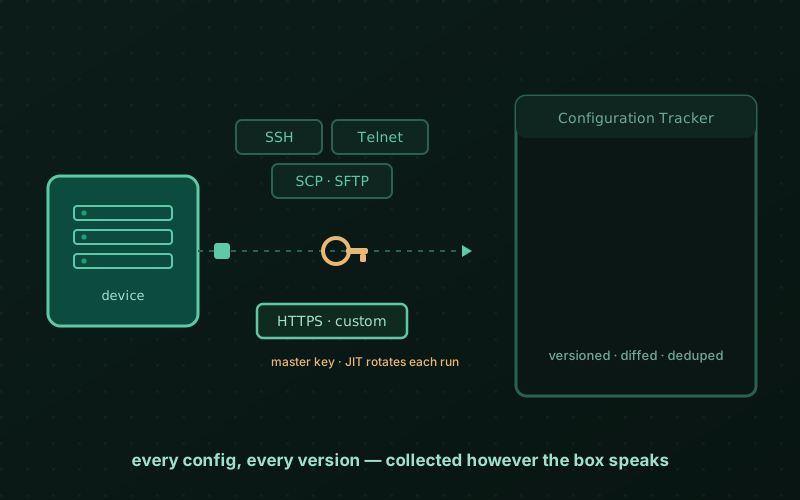
A couple of weeks ago we published the shape of Configuration Tracker — a design doc, no code, just locked decisions. Today it’s 1.1.0, and the tracker is real. It backs up, versions and diffs your device configs — and because Taranac is already your AAA server, it does two things a standalone backup tool structurally can’t: it can log in with a throwaway password nobody has ever seen, and it can tell you who typed each change.
Point a tracked config at a device, pick a recipe (which commands to run, plus scrub sets that mask secrets and strip volatile lines before anything is stored), and Taranac captures a versioned snapshot on a schedule or on demand. Every capture is content-hashed and deduped, rendered in a side-by-side diff, and you can mark any version as the baseline — plus add your own labels. A config-status column then flags drift the moment a capture stops matching that baseline, and starter recipes + scrub sets ship for a range of vendors.
Collect over whatever the box speaks
A tracked config reaches its device however that device is happiest to be read:
- SSH and Telnet for CLI gear — run the show/running commands and capture the output.
- SCP and SFTP for kit that hands you a config as a file — pull the blob straight off the device.
- HTTPS (and plain HTTP) for API-driven platforms. And this is the open door: an HTTP recipe carries its own request — path, headers, body — so you can author a custom recipe to fetch essentially any file or endpoint a device exposes, not just a fixed command set. If it answers over an API, you can track it.
Two ways to hold the keys
Device logins live in an encrypted credentials vault. Every stored secret is Fernet-encrypted with the deployment’s master key, per value, at rest — the plaintext never sits on disk and is never returned by the API.
But the vault isn’t the interesting part. The interesting part is not storing a password at all — and this is where being the AAA server changes the game. Taranac doesn’t just use the account it logs in with; it owns it. So a tracked config can authenticate with a just-in-time credential: at collection time Taranac mints a strong, 32-character random password on a managed local account, logs in with it for that one run, and rotates it away the moment the job drains.
Follow what that removes. The service account an automated system uses to reach your whole fleet is the classic soft target — a shared password sitting in a config file, reused for months, one leak away from a fleet-wide compromise. A JIT account has none of those handles:
- Nobody has ever seen it. The password is machine-generated and never displayed — not in the UI, not in logs, not over the API. There is no human copy to phish, paste or forget in a wiki.
- It’s genuinely strong. 32 random characters, not a memorable string a person picked.
- It’s already gone. It rotates on every collection, so a password sniffed off the wire is dead before it’s useful — and tomorrow’s doesn’t exist yet.
For the account that reads your configs, service-account compromise simply stops being a category of risk that applies to you.
Who typed what, delivered
The other AAA dividend: open any change and the AAA Activity drawer shows who logged into that box, which commands they ran, and the session accounting — scoped to the exact window between the two config versions. The diff and the culprit, side by side, no extra plumbing. (Per-command attribution needs TACACS+; a RADIUS-only device still gives you who-logged-in and session accounting — an honest limit, not a bug.)
Collection itself runs through a collector — the embedded one needs no setup and covers the single-site case; a dial-out standalone collector handles segmented and remote networks. That part deserves its own post, and it’ll get one.
Self-hosted, artifact-only, Elastic License 2.0. Same as always: kick the tyres, file issues, tell us what’s rough.